
Pre-Tied Rebar Cages for Houston Jobsites
Houston Reinforcing Steel builds pre-tied rebar cages for concrete contractors, general contractors, foundation contractors and builders across the Greater Houston area. We assemble cages for drilled piers, columns, footings, grade beams and pile caps from your drawings, tag them by mark and deliver them to the jobsite ready to set.
A cage that arrives tied and checked saves your crew hours of layout and tying in the heat, and it takes one more variable out of the pour schedule. Because we supply and install, one written quote can cover the cages, the loose bar that goes with them, delivery and, if you want it, placing. Send your drawings and we will price the job in writing.
Call to talk through your cage order.
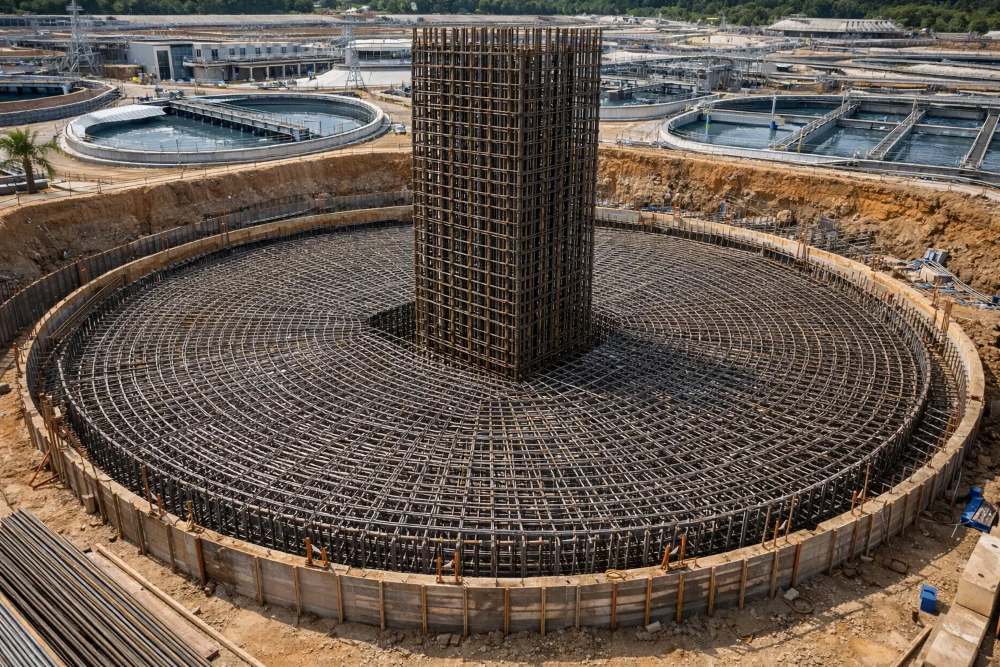
Types of Rebar Cages We Build
Every cage is a set of main bars held in position by ties, hoops or spirals. What changes from job to job is the shape, the length and how the cage will be lifted and set. These are the cages we quote most often.
Drilled Pier and Shaft Cages
Many commercial, institutional and industrial foundations around Houston bear on drilled piers, also called drilled shafts or caissons. A pier cage is a ring of vertical bars tied inside circular hoops or a continuous spiral, with spacers on the outside so the cage sits centered in the hole with the specified cover. Belled piers use a straight cage in the shaft; the bell itself is usually unreinforced unless the engineer calls for steel there.
Pier cages range from short residential piers to long shafts for heavier structures. Tell us the shaft diameter, the cage length, the projection above the top of the pier and any dowels or anchor bolt templates that tie into the cap or grade beam above.
Column Cages
Column cages are square, rectangular or round, built from vertical bars and ties or spirals at the spacing on the column schedule. Under ACI 318, ties must be at least #3 bar around longitudinal bars #10 and smaller, and at least #4 around #11, #14 and #18 bars or bundles. Your drawings set the actual size and spacing, including any tighter tie spacing near the top and bottom of the column.
Pre-tied column cages are especially useful on multi-story work, where the lap splices, offsets and dowels at each level need to be right before the forms close.
Footing, Grade Beam and Pile Cap Cages
Spread footings, continuous footings, grade beams and pile caps can arrive as tied cages or mats instead of loose bundles. Grade beams are common on Houston slab-on-grade and pier-and-beam foundations, and a pre-tied beam cage with its stirrups already set can drop straight into the trench. Large mats and caps may be built in sections sized for the truck and the crane, then spliced in place.
If a cage is too large to ship in one piece, we will tell you in the quote and show where the field splices go.
What Goes Into a Rebar Cage
A clear drawing gives us everything below. If any line is missing, we ask before we build, because a cage that is tied wrong is slower to fix than one that was never started.
| Component | What it does | What we need on the drawing |
|---|---|---|
| Main (longitudinal) bars | Carry the load along the length of the pier, column or beam | Bar size, number of bars, length, lap or splice locations |
| Ties, hoops or spirals | Hold the main bars in place and confine the concrete | Bar size, spacing, any tighter spacing zones, hook type |
| Dowels and projections | Connect the cage to the cap, beam, slab or column above | Projection length, hook or straight end, embedment |
| Spacers and centralizers | Keep the specified concrete cover between the cage and the soil or form | Required cover and spacer type, if specified |
| Stiffeners and lifting points | Help long cages keep their shape when picked and set | Lifting method and any engineer-specified stiffening |
For concrete cast against and permanently exposed to earth, which describes most drilled piers and many footings, ACI 318 calls for at least 3 in of cover. Your specifications may require more, and they control.
Example: Estimating the Weight of a Pier Cage
Weight drives both price and handling, so it helps to rough it out early. This example is an illustration only; your drawings control. Take a 30 in diameter drilled pier with a 20 ft cage, eight #8 vertical bars and #4 circular ties at 12 in, with 3 in of cover.
| Item | Quantity | Length | Weight per foot | Approx. weight |
|---|---|---|---|---|
| #8 vertical bars | 8 | 20 ft each (160 ft) | 2.670 lb | 427 lb |
| #4 circular ties, 24 in outside diameter | 21 | About 7.2 ft each, including lap (150 ft) | 0.668 lb | 100 lb |
| Total cage | About 530 lb |
Multiply by the number of piers and the steel adds up quickly: forty of these piers is more than 10 tons. Bar weights are nominal ASTM values. The free rebar calculator totals linear feet and weight from the lengths you enter, so you can check a takeoff before you send drawings.
Pre-Tied Cages or Tying in the Field?
Not every job needs pre-tied cages. Loose bar tied in place still makes sense for small residential pours, for one-off shapes that are easier to build where they sit, and for congested areas where the bars have to be threaded around embeds and other steel. The table below compares the two approaches so you can decide element by element.
| Consideration | Pre-tied cages | Loose bar tied on site |
|---|---|---|
| Field labor | Less tying on site; the crew sets and secures the cage | The crew lays out and ties every bar in place |
| Schedule | Cages can be ready before the hole or forms are | Tying time sits on the critical path before each pour |
| Repeat elements | Best when many piers, columns or footings share one design | Workable for a handful of different shapes |
| Handling | Needs room to unload and a plan to lift long cages | Bundles are easier to move by hand on tight sites |
| Inspection | Bar count and spacing are checked before the cage ships | Everything is checked in place before the pour |
Many projects use both: cages for the piers and columns that repeat across the site, and loose cut-and-bent bar for slabs, edges and odd pieces. We can quote either way, or split the order, from the same set of drawings.
Houston Conditions That Shape a Cage Order
Expansive Clay and Deep Foundations
Much of the Houston area sits on expansive clay that swells when wet and shrinks when dry. That is one reason engineers here so often carry structures on drilled piers that reach below the active zone, tied together with grade beams. The pier depth, diameter and reinforcing come from the geotechnical report and the structural design, so we build to your drawings and leave those decisions with your engineer of record.
Rain, Humidity and Jobsite Storage
Houston's rain and humidity are hard on steel that sits on the ground. Light, tight surface rust is normal on uncoated rebar and is generally acceptable; mud, oil, loose scale and flaking rust are not. Store cages on dunnage off the ground, keep them out of standing water and set them as close to the pour as the schedule allows. If your project calls for epoxy-coated or galvanized bar, it is available by special order, and coated cages need extra care when they are lifted and tied.
Hurricane season runs from June 1 to November 30. When a storm threatens, talk to us early about holding or rescheduling a delivery rather than leaving cages exposed on an open site.
Tight Sites and Long Cages
Downtown, Medical Center and Galleria-area sites often have little room for a truck to stage, and long pier cages need space to unload and a plan to pick them. Tell us the cage lengths, the street and gate access, any delivery time windows and what lifting equipment will be on site. The lifting plan, rigging and crane are the contractor's responsibility unless we are quoting the installation.
How We Quote, Build and Deliver Cages
What to Send for a Quote
We accept PDF plans, DWG files and marked-up sketches, and every quote is in writing. For an accurate number on the first pass, include:
- Structural drawings, the pier, column or footing schedules and the specifications
- The geotechnical report or pier details, if cage lengths depend on it
- Project address and ZIP code, plus any site access or delivery time limits
- Bid deadline, required delivery date and whether you want deliveries phased
Shop Drawings and Approval
We prepare shop drawings from your structural plans and submit them to the engineer of record for approval before fabrication. If you already have an approved bar schedule from your own detailer, send it and we will quote and build from it. If the drawings change after we quote, send the revision; revision pricing is quoted if a contract is awarded.
Fabrication, Tagging and Delivery
Bars are cut and bent to the approved schedule, which can include sizes #3 through #18, then tied into cages and checked against the drawing: bar count, bar size, tie spacing, overall length and projections. Each cage is tagged by mark and location. We schedule delivery by project address and requested date and confirm the window before dispatch. Plan for truck access to a reasonably level, unobstructed unloading area.
What Affects the Price of a Rebar Cage
There is no flat rate for cages, because the price follows the steel and the labor in each one. These are the main factors:
| Factor | How it affects price |
|---|---|
| Steel market price | Cages are priced from the current cost of the steel, by weight |
| Total tonnage | More cages of the same mark spread setup time over more pieces |
| Tie or spiral spacing | Tighter spacing means more ties to bend and more connections to make |
| Cage length and stiffening | Long cages take more handling and may need extra stiffening |
| Variety of marks | Many different cage types cost more to build than repeats of one design |
| Coating | Epoxy-coated and galvanized bar costs more and needs extra handling |
| Delivery distance and phasing | Longer runs, oversize loads and multiple drops add freight |
Turnaround depends on the size of the order, how complete the drawings are, shop drawing approval and current shop workload. Your written quote states the delivery date we commit to.
Areas We Serve Around Houston
We deliver rebar cages throughout Harris County and the surrounding counties, including Katy, Cypress, Spring, Humble, Kingwood, Pasadena, Baytown, Sugar Land, Missouri City, Pearland, League City, Friendswood, The Woodlands, Conroe and Galveston. Distances and the full list are in the delivery section on our Home page. Every delivery is confirmed by project address, and all material is delivered; there is no pickup at our downtown office.
Rebar Cage FAQs
How much does a rebar cage cost in Houston?
It depends on steel prices, bar sizes, tie spacing, cage length, the number of cages, coating and delivery. Send your drawings and we will give you a written price for your job.
Can you build cages from my pier or column schedule?
Yes. We build from your approved shop drawings or bar schedule, or we prepare shop drawings from your structural plans and submit them to the engineer of record for approval.
Do you install the cages?
We are a supply and install company, so installation can be quoted by project. Ask for it when you request your quote and we will include it with the material.
How much concrete cover does a drilled pier cage need?
ACI 318 requires at least 3 in of cover for concrete cast against and permanently exposed to earth. Your project specifications may require more, and spacers are sized to hold that cover.
Do you deliver to Katy, The Woodlands and Pearland?
Yes. Katy is about 29 miles west of downtown Houston, The Woodlands about 30 miles north and Pearland about 17 miles south, and all three are in our delivery area. Every delivery is confirmed by project address.